
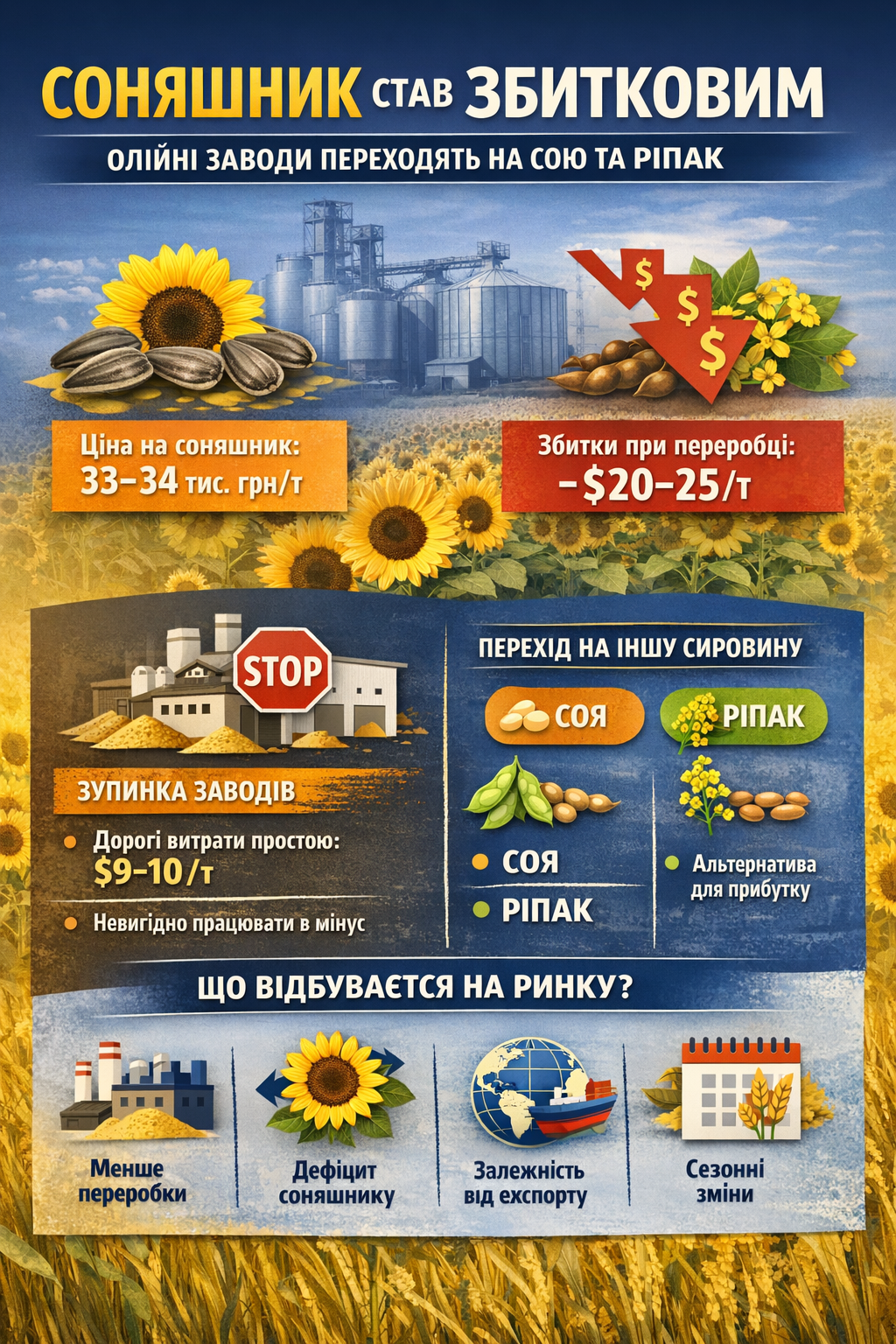
Sunflower seeds have become unprofitable: Ukrainian oilseed processors switch to soybeans and rapeseed
Зміст
- 1 The oilseed market is entering a phase of sharp restructuring
- 2 The main reason for the crisis is record-high sunflower seed prices
- 3 Why shutting down a plant can be more profitable than operating
- 4 Who is still processing sunflower seeds
- 5 Shift to soybeans and rapeseed: a new survival model for processors
- 6 Why sunflower is losing priority
- 7 Regional structure of processing
- 8 When the market may stabilize
- 9 Overall balance of the oilseed market
- 10 Conclusion
The oilseed market is entering a phase of sharp restructuring
Ukrainian oil extraction plants (OEPs) are increasingly reducing or completely stopping sunflower seed processing.
The reason is a sharp deterioration in processing margins caused by high raw material prices, which has made sunflower processing economically unprofitable.
According to market participants, in the current conditions it is often more profitable to stop production than to operate at a loss.
The main reason for the crisis is record-high sunflower seed prices
The key factor is the rapid increase in raw material costs.
Market conditions show that:
- sunflower seed purchase prices reach UAH 33,000–34,000 per ton;
- at such levels, processing margins disappear completely;
- plant operations become loss-making.
Traders explain that even under normal capacity utilization, the economics of processing break down.
Why shutting down a plant can be more profitable than operating
The financial logic of companies currently looks paradoxical.
If a plant:
- operates—it may lose $20–25 per ton processed;
- remains idle—it incurs only fixed costs of about $9–10 per ton of capacity.
These costs include:
- staff salaries;
- equipment maintenance;
- basic operating expenses.
👉 Conclusion:
It is better to lose $9–10 during downtime than $20–25 during production.
Who is still processing sunflower seeds
Despite the crisis, part of the industry continues operations.
These are mainly plants that:
- purchased raw materials in March–April;
- have existing stockpiles of sunflower seeds;
- are not forced to buy raw materials at peak prices.
These companies currently support the remaining processing volumes in the country.
Shift to soybeans and rapeseed: a new survival model for processors
Due to the lack of profitability in sunflower processing, plants are increasingly switching to alternative crops:
- rapeseed — as a short-term substitute;
- soybeans — as a more stable raw material with predictable economics.
Reasons for the transition:
- lower purchase prices;
- availability of supply on the market;
- ability to maintain zero or positive margins.
In some regions, rapeseed has become the main crop for plant utilization.
Why sunflower is losing priority
Although sunflower is traditionally Ukraine’s key oilseed crop, the situation has changed.
Reasons include:
- strong competition among processors for raw material;
- shrinking free supply volumes;
- rapidly rising purchase prices.
As a result, economically available sunflower seed volumes are decreasing.
Regional structure of processing
Analysts note that the situation is uneven:
- plants with integrated business models or additional assets can partially maintain processing;
- others are forced either to shut down or fully switch to alternative crops;
- companies without their own raw material base are under the greatest pressure.
When the market may stabilize
According to traders, the next factor of change is seasonality:
- part of remaining sunflower stocks may be sold by early summer;
- active selling is expected in the first half of June;
- afterward, the market will transition to a new harvest cycle of rapeseed and barley.
Overall balance of the oilseed market
Ukraine remains one of the world’s key sunflower oil producers, but the internal processing structure is changing.
The situation is driven by three main factors:
- raw material prices;
- availability of alternative crops (soybeans and rapeseed);
- export market conditions.
Rapeseed and soybeans are gradually becoming backup crops to stabilize processing operations.
Conclusion
The sunflower seed market in Ukraine has entered a phase of structural transformation. Record-high seed prices have destroyed processing margins, forcing oilseed plants either to shut down or switch to soybeans and rapeseed.
In the short term, this leads to lower utilization of processing capacity, while in the long term it reshapes the entire structure of the country’s oilseed processing industry.